Makoto Sakuma and Jeffrey Weeks, Examples of canonical decompositions of
hyperbolic link complements
Francois Gueritaud, David Futer, On canonical triangulations of once-punctured torus bundles and two-bridge link complements
Jessica Purcell, Hyperbolic Geometry and Knot Theory (book), Chapter 10
Cubes with diagonals
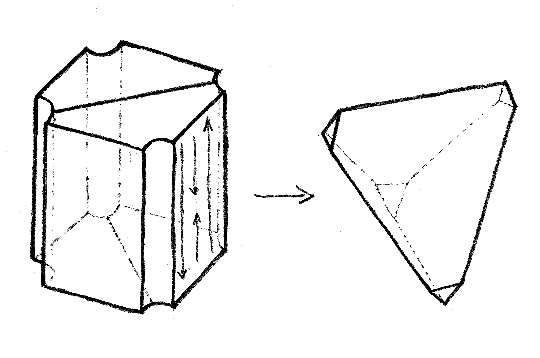
We will build the link complement out of cubes with diagonals. The triangulation is obtained by crushing the vertical faces:
Layers made out of two cubes each
Cut the two bridge link into layers S2×I such that each layer contains one crossing. Such a layer can be decomposed into two cubes. Here is how one of the cubes embeds (video):
Closing up the link
At the top and bottom layer, we fold the faces to close up the link (Video, note: not quiet correct, the red link should be inside the initial tetrahedron):
Triangulation of generic link complement
References
Jeffrey Weeks, SnapPea kernel link_complement.c
Jinseok Cho, Seokbeom Yoon, Christian K. Zickert, On the Hikami-Inoue conjecture (Figure 2)
Decomposition into topological squares
The dual to link diagram is a 2-complex of topological squares, each containing exactly one crossing.
Box tangle
For each square, use a box with the crossing drilled out.
Pinch box
Pinch the box:
Cut into tetrahedra
The pinched box can be cut into 4 truncated tetrahedra:
Isotope to fill gap
The neighboring boxes can be isotoped to fill the gaps from the pinching. Here it is shown for alternating links: